
It usually starts with a list. Read every day, run three times a week, drink more water, meditate, journal, sleep before eleven, learn Spanish. Two weeks later the list is still on the fridge, and none of it is happening.
The problem isn’t the habits. Each one on its own is reasonable. The problem is starting all of them on the same Monday. Here is what research says about how many habits to build at once, and how to grow the list without it collapsing.
The short answer
Start with one habit. Add the next one when the first runs mostly on its own, usually after a few weeks. Keep the whole list short: three to five habits you actually do beats twelve you track.
One is not a rule carved in stone. It’s the setting that gives a new habit the best chance, because at the start every habit needs your attention, and attention is the thing you have least of.
What research says
New habits need attention before they need willpower. In a 2010 study at University College London, Phillippa Lally and her colleagues followed 96 people who each picked one new daily behavior. Automaticity rose fastest in the first weeks and then leveled off, with a median of 66 days to reach a plateau and a range from 18 to 254 days. In those early weeks you have to remember the habit, make room for it and push through the days you don’t feel like it. That is manageable for one habit. For five it is a part-time job.
Plans work worse when there are too many of them. If-then plans (“after I pour my coffee, I write one line in my journal”) are one of the best-studied tools for following through. But in a 2012 paper in the Journal of Consumer Research, Amy Dalton and Stephen Spiller found that their benefit depends on the number of goals: people who planned for a single goal followed through better, while planning for several goals at once made the goals feel harder and the advantage faded.
Early wins matter. The first habit that sticks changes what you believe about yourself. One habit kept for a month does more for the next one than five habits dropped in a week.
How to know a habit is ready
You don’t need to wait 66 days. Look for these signs instead:
- You do it at the usual moment without deciding to.
- Skipping it feels odd, like leaving the house without your keys.
- On a bad day, the smallest version still happens.
- You haven’t missed twice in a row for a couple of weeks.
When most of these are true, the habit needs less of you. That is the moment to add the next one.
How to add the next habit
- Anchor it to the habit you already have. If you meditate every morning, write the new one as “after I meditate, I stretch for two minutes.” The first habit becomes the cue for the second.
- Start it tiny. Two minutes, one page, one glass. You can grow it later, once it happens every day.
- Give it its own goal. A habit you want to keep for 30 days and one you want for 100 days deserve different finish lines.
- Keep the first habit protected. If adding the second one starts to break the first, drop back to one. That’s not failure; it’s information about timing.
What counts as one habit
A morning routine of water, stretching and a page of reading can count as one habit if it always starts from the same cue and runs as a sequence. What makes something one habit is one trigger, not one action. Three unrelated habits at three different times of day are three habits, however small each one is.
The same goes for replacing a habit. Swapping the evening scroll for a book is still one new habit to build, even if it frees time.
Is there a maximum?
Research doesn’t give an exact number, but practice gives a good one. Past five daily habits, a tracker turns into a checklist you rush through, and the point of each habit gets lost. If you track more than that, look for habits that already run on autopilot and stop tracking them. They don’t need the reminder anymore.
Questions people ask
Can I build two habits at the same time?
You can, especially if one is tiny and both hang on the same cue, like brushing teeth and then flossing. Two unrelated, demanding habits started together are where most people stumble.
How long should I wait before adding a new habit?
Usually two to eight weeks. Watch for the signs above rather than counting days: when the first habit happens on autopilot most days, it’s ready.
I already track ten habits. What should I do?
Keep the three that matter most this month and the ones that are still hard. Retire the ones you do without thinking. A shorter list you complete every day feels better and works better than a long one you half-finish.
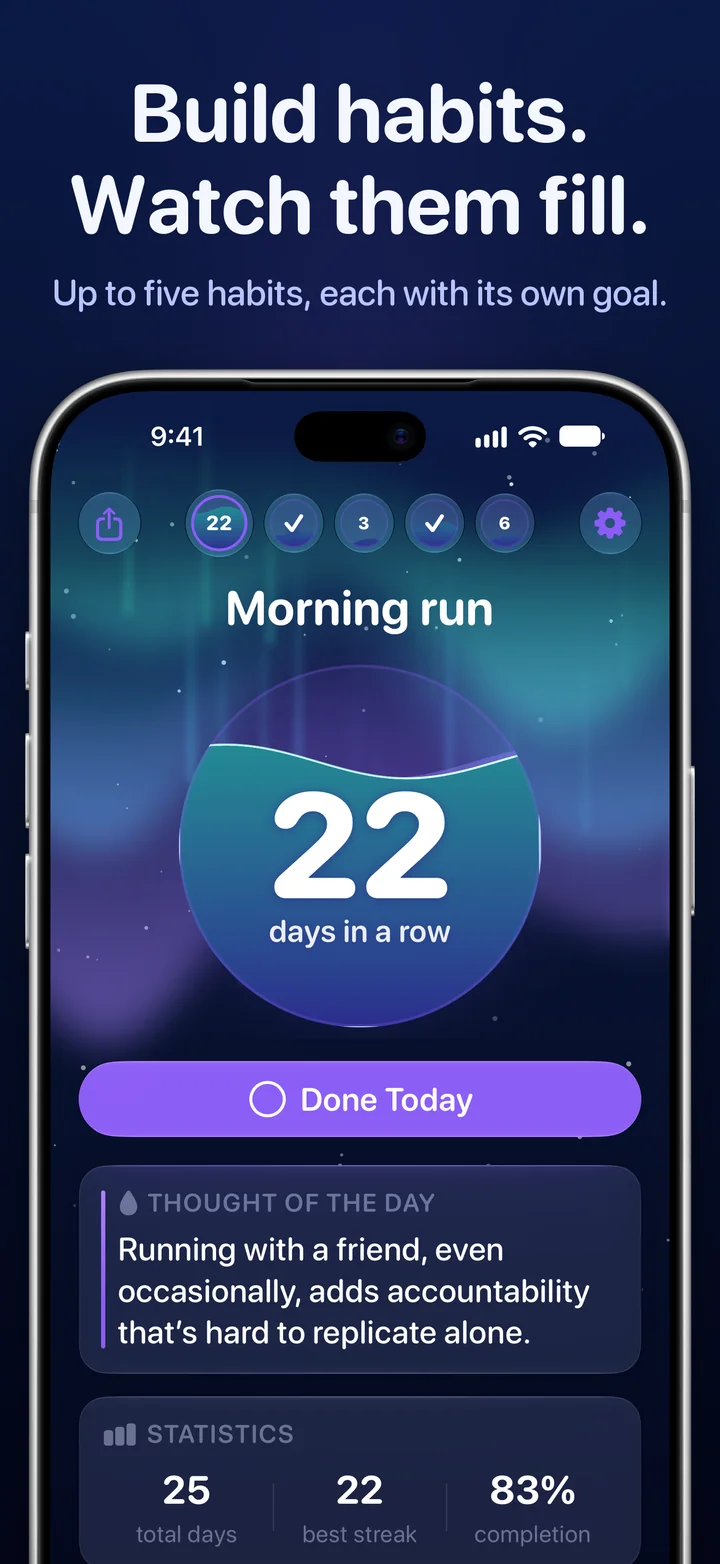
Keep a short list in Ripply
Ripply is a habit tracker for iPhone and Apple Watch built around a short list: five habits at most, each with its own goal. The row at the top of the screen shows your whole day at a glance, every habit as a little vessel of water with a checkmark once it’s done.
Start with one, watch its water fill, and add the next when it’s ready. Ripply is free to download, with no subscription, no account and no ads.
 Ripply
A free habit tracker for iPhone and Apple Watch. Set a goal of 7 to 100 days, mark each day in a second, and keep your streak with freezes.
 More about Ripply →