
A 21-day challenge is a good idea wrapped in a shaky promise. Three weeks is long enough to feel a change and short enough to say yes to without dread. The promise that comes with it, “do anything for 21 days and it becomes a habit”, doesn’t hold up.
That doesn’t make the challenge useless. It just changes what it’s for. Here is where the number came from, what researchers measured instead, and how to run a 21-day habit challenge that still works on day 22.
Where “21 days” comes from
In 1960 a plastic surgeon, Maxwell Maltz, published a self-help book called Psycho-Cybernetics. He had noticed that his patients needed about three weeks to get used to a changed face, and he wrote that it takes “a minimum of about 21 days” for an old self-image to give way to a new one.
He was describing getting used to a change, not building a habit, and he said “minimum”. Over the years both details fell away and “21 days” turned into a rule. In 2012 the health psychologists Benjamin Gardner, Phillippa Lally and Jane Wardle called the 21-day figure a myth in the British Journal of General Practice.
What research found instead
In 2010 Phillippa Lally and her colleagues at University College London asked 96 volunteers to pick one healthy behavior, such as drinking water with lunch or going for a run before dinner, and to do it every day in the same situation for 12 weeks. Every day the volunteers rated how automatic it felt.
For the participants whose data the researchers could model, it took a median of 66 days for the behavior to become about as automatic as it was going to get. Individual times ranged from 18 to 254 days. A few people got there in under three weeks. Most did not.
A 2024 review by Singh and colleagues pulled together 20 studies. The four that measured time to habit reported medians of 59 to 66 days, with individual times from 4 to 335 days.
One more finding matters for a 21-day challenge: in Lally’s study, automaticity grew fastest at the start and then leveled off. The first weeks of repetition do the most work. A 21-day challenge won’t finish a habit, but it covers the steepest part of the climb.
How to set up your 21-day challenge
- Choose one habit. One, not three. You can add the next one later.
- Write it as a sentence with a cue: “After I pour my morning coffee, I write one line in my journal.” The cue is something that already happens every day, in the same place.
- Make the daily version small enough for your worst day: two minutes, one page, one glass.
- Decide what counts as done. “Running shoes on and out of the door” can count, even if the run is short.
- Mark each day right after you do it, in a calendar or a habit tracker, so the progress stays visible.
- Decide now what happens if you miss a day: you simply do it the next day. No restarting from zero.
A 21-day plan, week by week
| Week | Focus | Checkpoint |
|---|---|---|
| Days 1–7 | Show up. Do only the small version, even if it feels too easy. | Seven marks, whatever their size. |
| Days 8–14 | Protect the cue. Notice what got in the way and fix the timing, not the size. | Starting takes less arguing with yourself. |
| Days 15–21 | Make it yours. If the small version feels effortless, add a little. | You remember it without a reminder on most days. |
The middle week is usually the hardest. The novelty is gone and the habit isn’t automatic yet. That’s normal, and it’s the week when a tiny daily version earns its keep.
21-day challenge ideas
Pick something you can do every day, at the same moment:
- Health: a glass of water right after you wake up, a 10-minute walk after lunch, five minutes of stretching before bed.
- Mind: five pages of a book, one line in a journal, three slow minutes of breathing before you open your email.
- Skills: five new words in a language, ten minutes of an instrument, one quick sketch.
- Home and money: put one thing back in its place when you get home, write down what you spent today.
- Screen time: no phone for the first 15 minutes after you wake up.
Simple, small actions tend to settle sooner. In Lally’s study there was a trend, not a statistically significant one, for actions like drinking water to become automatic faster than harder ones like doing 50 sit-ups.
What day 22 is for
Day 22 is a checkpoint, not a graduation. Ask yourself one question: is it easier to start now than it was on day 1?
- If yes, keep going. Many habits need two months or more, so a natural next step is to extend the challenge, for example to 66 days. Our guide to the 66-day habit challenge explains what that number really means.
- If not yet, make the daily version smaller or move it to a steadier cue, and run another round.
Either way, don’t stop on day 21 just because the challenge says “done”. Stopping is the one thing that reliably undoes the work.
Common mistakes
- Taking on several new habits at once. Each one needs attention while it’s still effortful.
- Starting at full size. The 30-minute workout from day one is the version most likely to fall over on a tired Wednesday.
- Restarting from day 1 after one miss. In Lally’s study, missing a single day didn’t seriously harm habit formation. If a miss does happen, read what to do when a streak breaks.
- Treating day 21 as the finish line and stopping.
Questions people ask
Does it really take 21 days to form a habit?
No fixed number does. “21 days” goes back to a surgeon’s observation about getting used to a new appearance. The best-known study found a median of 66 days, with a range from 18 to 254 days.
Can I do a 21-day challenge with more than one habit?
You can, but one habit is easier to keep going. If you want two, make both tiny and tie each one to its own cue.
What if I miss a day during the challenge?
Do it the next day and keep counting. One missed day doesn’t erase the repetitions you’ve already done. Many missed days do add up, so make tomorrow’s version small enough to be sure of.
Run your 21-day challenge in Ripply
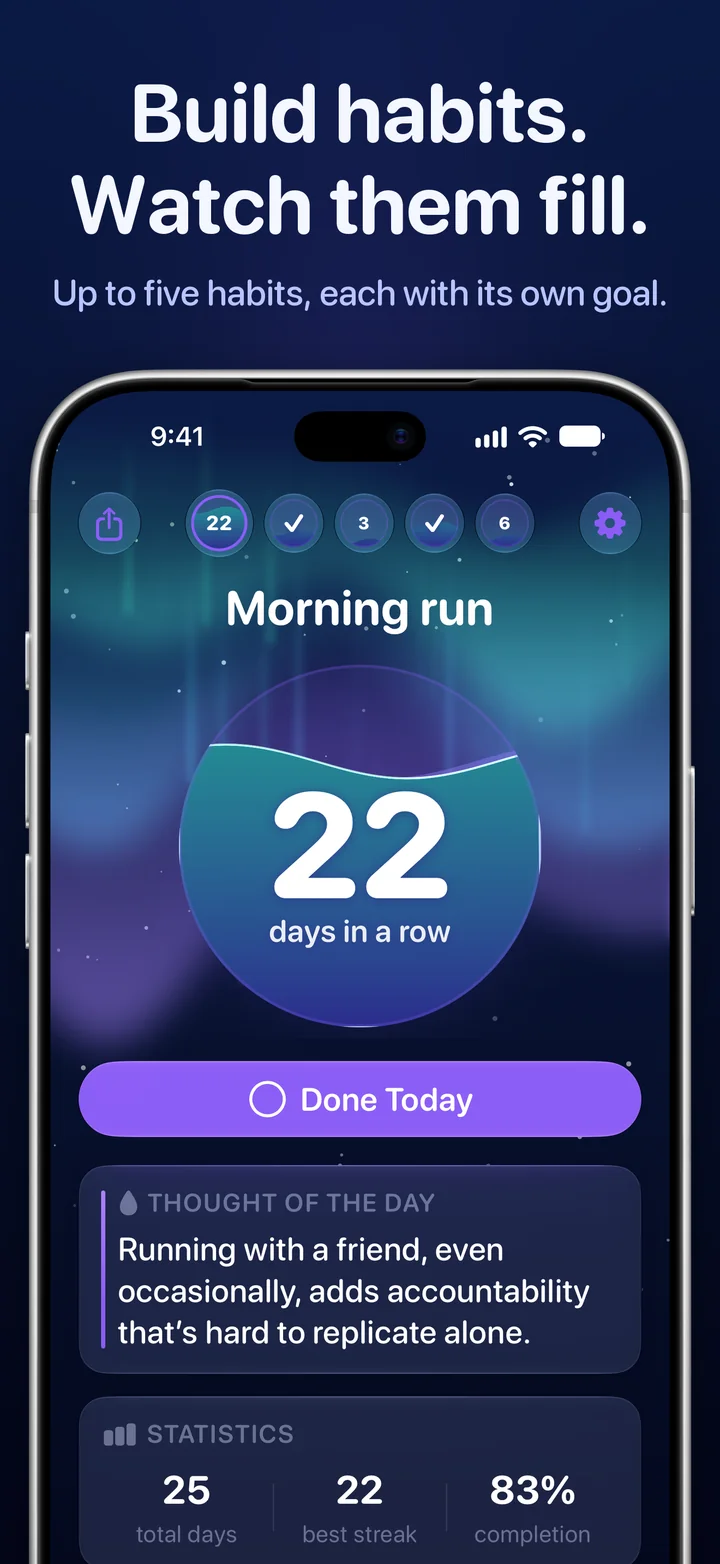
Ripply is a free habit tracker for iPhone and Apple Watch. Create a habit and choose the 21-day goal: your habit becomes a sphere of water, and every day you press and hold it to mark the day, the water rises a little closer to the goal. You can also mark it from a Home Screen widget, with Siri or on Apple Watch.
Every full week without a miss earns you a streak freeze, so one bad day in week three doesn’t wipe out the challenge. When you reach day 21, you can raise the goal to 30, 50, 66 or 100 days and keep going. No subscription, no account and no ads.
 Ripply
A free habit tracker for iPhone and Apple Watch. Set a goal of 7 to 100 days, mark each day in a second, and keep your streak with freezes.
 More about Ripply →