
“It takes 66 days to form a habit” sounds like the grown-up version of the 21-day myth. This time the number comes from a real study. But it’s a median from one group of people, not a deadline for you, and the study behind it says more than the headline.
Once you know what was measured, 66 days becomes a useful length for a habit challenge: long enough to get past the hard middle, short enough to plan. Here is what the research found and a plan for the whole 66 days.
Where the 66 days come from
In 2010 Phillippa Lally and her colleagues at University College London published a study in the European Journal of Social Psychology. 96 volunteers each chose one healthy eating, drinking or exercise behavior and did it every day in the same situation, for example after breakfast, for 12 weeks. Every day they rated how automatic it felt: how much it happened without thinking or having to remember.
The typical pattern: automaticity rose quickly at first and then leveled off. For the 39 participants whose data fitted that curve well, out of 82 who finished the study, the median time to reach the plateau was 66 days.
What 66 days is not
- It isn’t a deadline. Individual times ranged from 18 to 254 days. The longest ones are estimates, because the study itself lasted 12 weeks.
- It isn’t the same for every habit. There was a trend, though not a statistically significant one, for simple actions like drinking water to settle faster than harder ones like doing 50 sit-ups.
- It isn’t a pass-or-fail exam. Missing one day did not seriously harm habit formation. Missing many days, even spread out, did add up: those habits ended up less automatic.
- It isn’t the final word. A 2024 review by Singh and colleagues collected 20 studies. The four that measured time to habit reported medians of 59 to 66 days, average times of 106 to 154 days, and individual times from 4 to 335 days.
So about two months is a fair guess for a simple daily habit, and much longer is normal too.
Why 66 days still makes a good challenge
The first weeks bring the biggest gains, and a 21-day challenge already covers them. Weeks four to eight are where many habits stall: the novelty is gone, and starting still takes effort. A 66-day challenge is built to carry you through exactly that stretch.
Nine and a half weeks is also long enough for real life to happen: a trip, a cold, a crazy week at work. Learning to come back after a disruption is part of the habit, and a short challenge never tests it.
A 66-day plan in three stages
| Stage | Days | Focus | When it gets hard |
|---|---|---|---|
| 1. Start small | 1–21 | Same cue every day, a version so small it’s almost silly. Mark it right away. | Make it smaller, not later. |
| 2. Get through the middle | 22–44 | Keep the cue steady. Plan ahead for weekends, trips and late evenings. | Fall back to the two-minute version, and don’t skip. |
| 3. Let it grow | 45–66 | If starting feels easy, add a little: two pages instead of one, ten minutes instead of five. | If the bigger version feels like a fight, go back to the small one for a week. |
On day 66, check how automatic it feels, using questions like the ones the study asked:
- Do I do it without having to remember?
- Do I start almost before I’ve decided to?
- Would it feel strange to skip it?
Mostly yes: the habit is well on its way, and the challenge has done its job. Not yet: you are within the normal range. Keep the habit going, make the cue clearer, and check again in a few weeks.
What to choose for 66 days
Daily actions in a stable situation work best, because that’s what the research tested:
- A glass of water when you sit down for breakfast.
- A 10-minute walk after lunch.
- Flossing right after brushing your teeth in the evening.
- Ten pages of a book once you’re in bed.
- Ten minutes of a language over your morning coffee.
A habit you only do some days of the week can work too, but it gets fewer repetitions in the same 66 days, so expect it to take longer.
Common mistakes
- Treating day 66 as a finish line. The plateau means it got easier, not that you can stop.
- Changing the cue every week. A habit needs the same situation to attach to.
- Restarting from day 1 after one miss. Pick it up the next day. Our guide on what to do when a streak breaks has a plan for the day after.
- Comparing your day count with someone else’s. The study found differences of months between people.
Questions people ask
So is it 21 days or 66 days?
21 days comes from a plastic surgeon’s observation about getting used to a new appearance. 66 days is a median from one study, with a range from 18 to 254 days. If you want a short first step, our 21-day habit challenge covers the first three weeks.
What if my habit still isn’t automatic after 66 days?
That’s within the range. Some participants were estimated to need up to 254 days, and the 2024 review found individual times of up to 335 days. Make the cue clearer, keep the daily version small, and keep going.
Do I have to do it every single day?
The study followed daily habits, so every day is the plan. One missed day is fine. Frequent misses slow the process down, so make your minimum version small enough for bad days.
Does it work for breaking a bad habit?
These studies looked at building new behaviors. Quitting is a different problem, but a new daily action in the same situation, like a walk instead of the afternoon snack, can be built exactly this way.
Track your 66 days in Ripply
Ripply is a free habit tracker for iPhone and Apple Watch, and 66 days is one of its built-in goals. Your habit becomes a sphere of water that rises with every day you mark, so the long middle of the challenge stays visible.
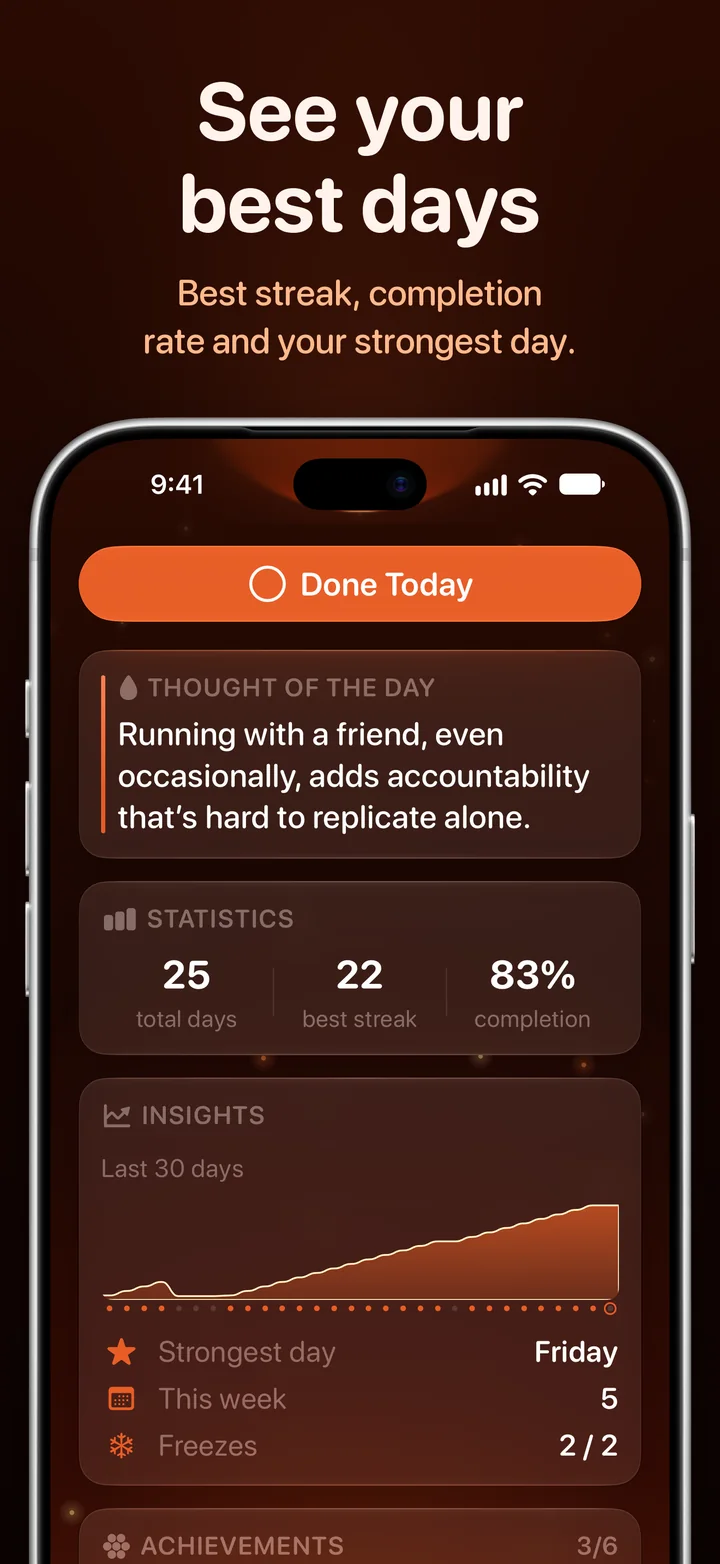
Each full week without a miss earns a streak freeze, so a cold in week six doesn’t wipe out the challenge. Insights show your completion rate and strongest weekday, which helps you spot a cue that isn’t working, and a note on each day helps you remember what got in the way. No subscription, no account and no ads.
 Ripply
A free habit tracker for iPhone and Apple Watch. Set a goal of 7 to 100 days, mark each day in a second, and keep your streak with freezes.
 More about Ripply →