
You had 23 days in a row. Then came a late flight, a sick child or a deadline, and the chain broke. It feels like the whole month went with it, and that feeling is what makes people quit.
It’s mostly wrong. Here is what one missed day really does to a habit, what the “never miss twice” rule means, how a streak freeze fits in, and what to do in the next 48 hours.
What one missed day really does
In 2010 Phillippa Lally and her colleagues at University College London followed volunteers who were building a new daily habit for 12 weeks. Missing a single day did not seriously harm the process: after one miss, the habit kept getting more automatic as before.
Missing often was a different story. Many misses, even spread out over the weeks, added up, and those habits ended up less automatic. So one missed day is an accident. A pattern of missed days is the real problem.
The streak is a tool, not the habit
“Don’t break the chain” is an old trick: mark every day you do the thing on a calendar, and soon you don’t want to break the chain. It’s usually credited to Jerry Seinfeld, through a story a young comic, Brad Isaac, told in 2007.
A visible chain works because progress you can see is motivating. But the chain counts days in a row, while the habit grows from repetitions in the same situation. When the chain becomes the goal, one gap looks like losing everything, and “I’ve already broken it” turns into “why bother”. The 23 days you did are still there. Only the counter reset.
The never miss twice rule
James Clear popularized the rule in his book Atomic Habits (2018): missing once is an accident, missing twice is the start of a new pattern. You can’t promise to never miss. You can promise to come back the very next day.
It isn’t a research finding with a number attached. It’s a practical rule that fits what the research shows: single misses are harmless, frequent ones add up. Its real value is that it moves your attention from the day you lost to the day you still have.
Your plan for the next 48 hours
- Don’t pay it back. No double workout, no 20 pages to make up for yesterday. Making up turns the habit into a debt.
- Shrink tomorrow. Do the smallest version that still counts: two minutes, one page, shoes on and out of the door.
- Use the usual cue, and earlier in the day if you can, before the day gets away from you.
- Find the cause in one sentence: the cue disappeared, the version was too big, the schedule changed. Fix that, not your character.
- Mark it as soon as it’s done. Seeing the day marked is what restarts the chain.
Plan for misses before they happen
- Define a minimum day in advance, the version you can do sick, late or tired.
- Make a travel version for trips and holidays. The cue changes when you travel, so choose a new one before you go.
- If your habit isn’t meant to be daily, like a workout three times a week, plan the rest days so they aren’t misses.
- Keep a buffer, such as a streak freeze, for the days when even the minimum doesn’t happen.
What is a streak freeze?
A streak freeze is a pass for one missed day: the streak survives, even though the day wasn’t done. Language apps made it popular, and many habit trackers have something similar.
A good freeze takes the all-or-nothing panic out of a missed day. A bad one makes the streak meaningless. The difference is whether freezes are earned and limited, or simply bought and unlimited.
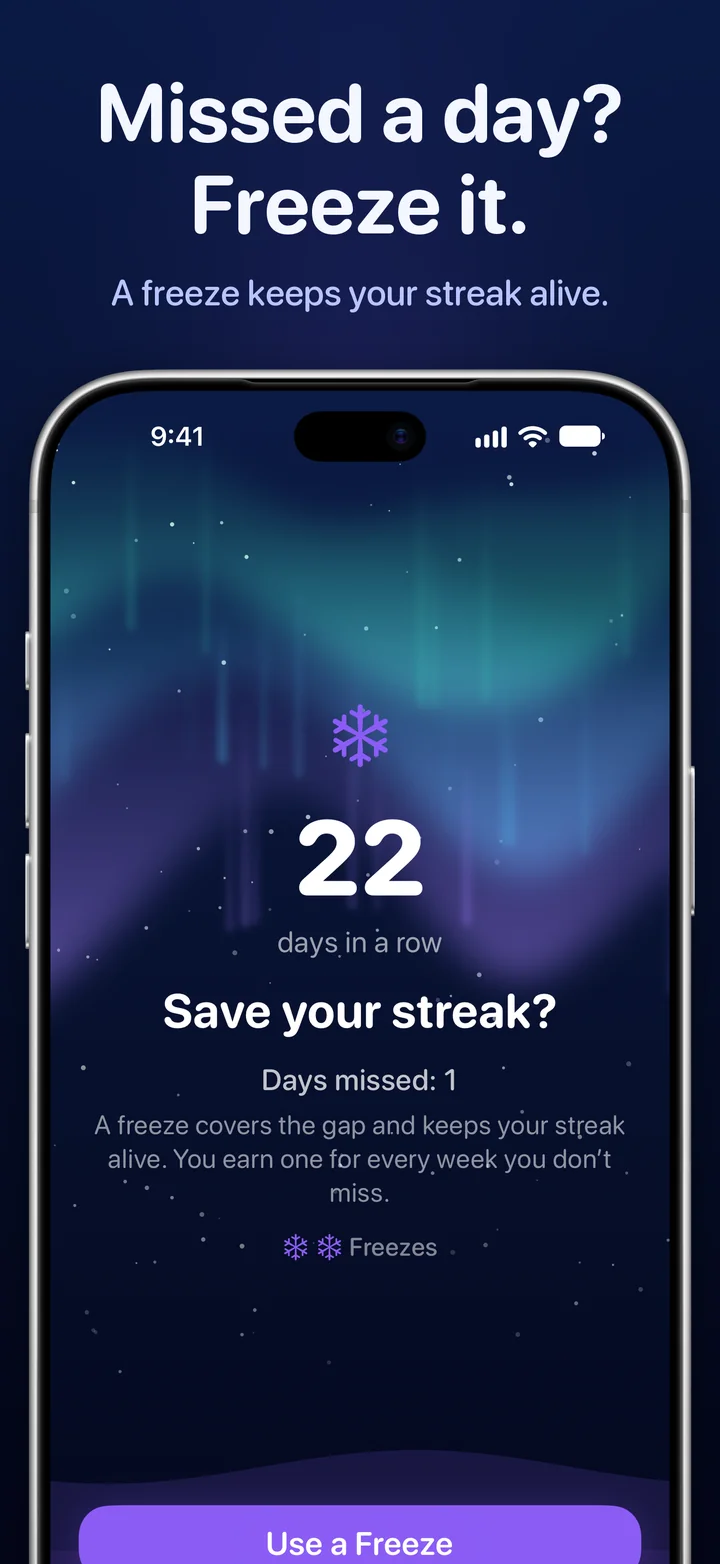
Here is how freezes work in Ripply:
- You earn one freeze for every full week (seven days in a row) that you keep a habit going, and you can hold up to two.
- When you come back after a missed day, Ripply asks “Save your streak?” and you choose “Use a Freeze” or “Let it end”.
- Freezes only save the streak if you have enough to cover every missed day.
- A frozen day keeps the chain together but doesn’t count as a completed day, so your total days and completion rate stay honest.
When the streak ends anyway
Sometimes the gap is too long, and that’s fine. Look at the number that matters more: total days done. A 23-day streak that ended still left 23 repetitions of the habit. Then start again from the smallest version, tomorrow, at the usual cue.
Questions people ask
Does breaking a streak reset my habit?
No. In Lally’s study, one missed day did not seriously harm habit formation. What slows a habit down is missing often, not missing once.
Is using a streak freeze cheating?
Not if it’s earned and limited. It covers a real-life gap without pretending the day was done, and it keeps one bad day from turning into a week.
How many days can I miss before the habit is gone?
Research doesn’t give a number. Single misses are fine, and many misses add up. That’s why “never miss twice” is a good rule of thumb: it keeps the misses single.
Keep your streak in Ripply
Ripply is a free habit tracker for iPhone and Apple Watch with streak freezes built in. Every full week without a miss earns a freeze, you can hold up to two, and a frozen day never counts as done. Mark your habit by pressing and holding the water, from a Home Screen widget, with Siri or on Apple Watch, so the comeback day takes a second.
If a streak does end, Ripply lets you start a new wave without guilt, and the calendar still shows every day you showed up. No subscription, no account and no ads.
 Ripply
A free habit tracker for iPhone and Apple Watch. Set a goal of 7 to 100 days, mark each day in a second, and keep your streak with freezes.
 More about Ripply →